EV Car Charging Cost in India: Home Charging Station Cost, Installation & Charging Price

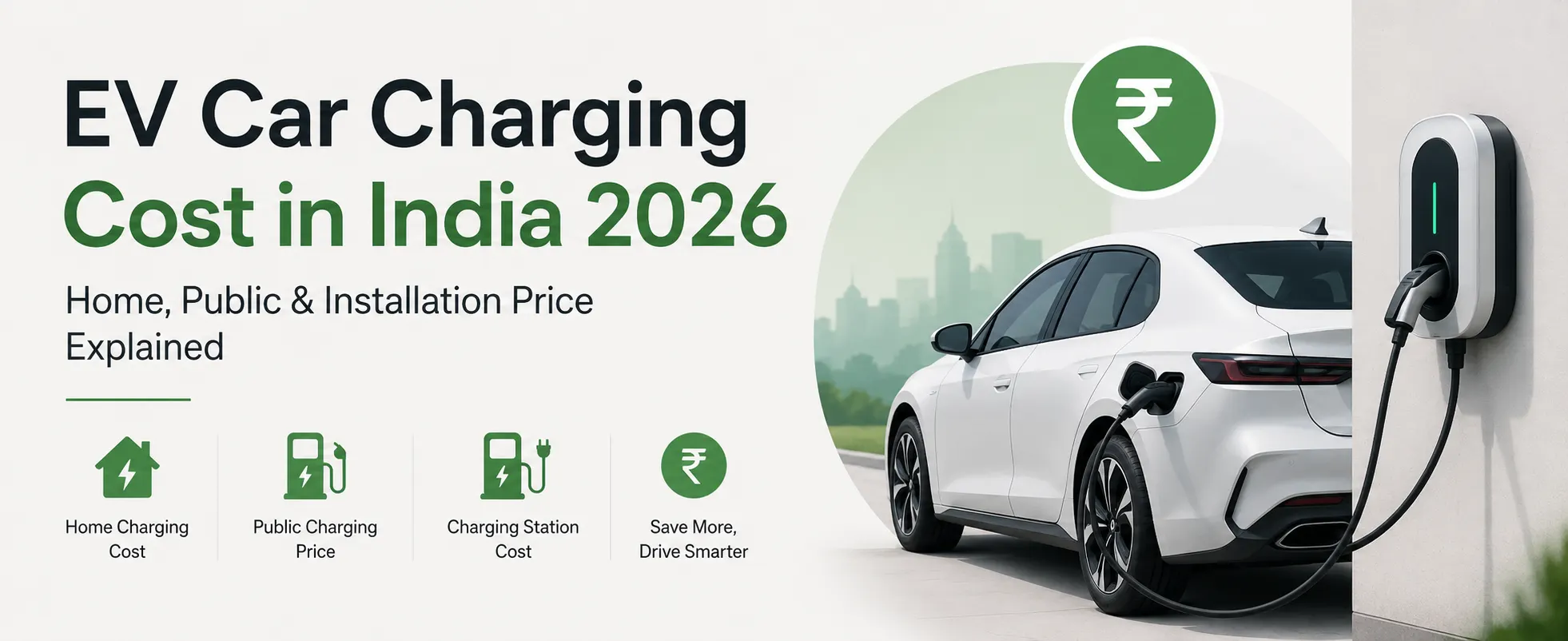
The EV car charging cost in India typically ranges from ₹150 to ₹600 for a full charge at home, depending on your EV’s battery size, local electricity tariff, and charger efficiency. Public charging generally costs more, with a full charge often ranging from ₹250 to ₹900, depending on the charging network, charger type, and state. For most EV owners, home charging is usually the more economical option for everyday use.
If you’re planning to buy an electric vehicle, it’s natural to wonder how much charging will add to your monthly electricity bill and whether installing a home charger is worth the investment. Understanding these costs can help you estimate your running expenses and choose the charging solution that best fits your driving needs.
In this blog, you will learn how EV charging costs are calculated, compare home and public charging prices, understand home charging station and installation costs, and understand state-wise electricity tariff differences.
What Is EV Car Charging Cost?
EV car charging cost is the amount you pay to charge your electric vehicle’s battery. It depends on four main factors: your EV’s battery capacity (kWh), your electricity rate (cost per kWh), charging losses that occur during the charging process, and your charger’s efficiency.
Formula to Calculate EV Charging Cost
Charging Cost = Battery Capacity × Electricity Rate × Charging Loss Factor
Charging Loss Factor accounts for the small amount of energy lost during charging. It is commonly estimated at 1.10–1.15 (10–15% charging loss), depending on the charger and vehicle.
Worked Example
Suppose your EV has a 40 kWh battery, your electricity tariff is ₹8 per kWh, and the charging loss factor is 1.10.
Charging Cost = 40 × ₹8 × 1.10 = ₹352
So, a full charge would cost approximately ₹350, although the actual amount may vary depending on your electricity tariff, charger efficiency, and battery condition.
EV Charging Cost in India
The EV charging cost in India varies mainly based on electricity tariffs, charging location, and battery size. For most residential users, electricity rates typically range between ₹6 to ₹10 per kWh, depending on the state and distribution company (DISCOM).
States like Tamil Nadu, Maharashtra, and Delhi have different slab-based pricing, which means the per-unit cost may increase with higher consumption.
Public charging is generally more expensive because operators include infrastructure, maintenance, and service charges.
Estimated EV Charging Cost in India
All values below are approximate and may vary based on electricity tariffs, efficiency, and location.
| Battery Size | Estimated Home Charging Cost (₹) | Estimated Public Charging Cost (₹) | Cost per km (Home) |
|---|---|---|---|
| 20 kWh | 140 – 220 | 200 – 320 | ₹1.0 – ₹1.5 |
| 30 kWh | 210 – 330 | 300 – 480 | ₹1.0 – ₹1.6 |
| 40 kWh | 280 – 440 | 400 – 650 | ₹1.1 – ₹1.7 |
| 50 kWh | 350 – 550 | 500 – 800 | ₹1.1 – ₹1.8 |
| 60 kWh | 420 – 660 | 600 – 950 | ₹1.2 – ₹2.0 |
Key Takeaways
- Home charging is usually 30–50% cheaper than public charging.
- Costs increase with battery size and electricity tariff slab.
- Public charging includes network and service charges, making it more expensive.
- Cost per km remains low for EVs compared to petrol or diesel vehicles.
EV Charging Cost by State
EV charging cost in India varies significantly from state to state because residential electricity tariffs are set by local DISCOMs (distribution companies). Most EV owners pay between ₹6 to ₹10 per kWh at home, but the exact rate depends on your state, consumption slab, and whether your connection is domestic or commercial.
Indicative Residential EV Electricity Tariffs by State
All values below are approximate residential tariffs for EV/home charging. Actual rates may vary based on usage slabs, subsidies, and DISCOM policies.
| State / Region | Indicative Tariff (₹/kWh) | Notes |
|---|---|---|
| Maharashtra | ₹7 – ₹9 | Slab-based pricing: higher usage increases the rate |
| Delhi | ₹6 – ₹8 | EV-specific tariff options available in some cases |
| Karnataka | ₹6 – ₹9 | Varies by BESCOM slab category |
| Tamil Nadu | ₹6 – ₹8 | Lower base tariff for domestic users |
| Gujarat | ₹6 – ₹7 | Relatively stable residential pricing |
| Telangana | ₹7 – ₹9 | Slight variation based on usage slab |
Key Points to Understand
- EV charging price by state depends on DISCOM policies and slab system, not just fixed rates.
- Some states may offer special EV tariffs or incentives, reducing per-unit cost.
- Domestic connections are cheaper than commercial or industrial tariffs.
- Final charging cost will still depend on battery size and charging efficiency, not just electricity rate.
EV Charging Cost vs Petrol Cost: How Much Do You Actually Save?
One of the most common questions buyers ask is whether an EV is actually cheaper to run than a petrol car. The answer depends on fuel prices, electricity tariffs, and how efficiently the vehicle is driven, but in most cases, EVs have a lower running cost per kilometre.
EV vs Petrol Cost Comparison (Indicative)
All values are approximate and may vary based on fuel prices, electricity tariffs, and vehicle efficiency.
| Vehicle Type | Cost per km (₹) | Annual Cost (12,000 km) |
|---|---|---|
| Petrol Car | ₹6 – ₹9 | ₹72,000 – ₹1,08,000 |
| Electric Vehicle | ₹1 – ₹2 | ₹12,000 – ₹24,000 |
What This Means
- EV running cost is typically 3–5 times lower than petrol vehicles in India.
- Annual savings depend heavily on driving distance and local electricity rates.
- Highway driving, aggressive acceleration, and AC usage can slightly increase EV consumption.
- Petrol prices and EV efficiency can change over time, so these are indicative estimates only.
Home Charging vs Public Charging: Which Is More Cost-Effective?
Choosing between home and public charging depends on cost, convenience, and usage patterns. In general, home charging is more cost-effective, while public charging is better suited for long-distance travel or situations where home charging is not available.
Home vs Public Charging Comparison
All values are indicative and may vary based on location, operator, and electricity tariffs.
| Factor | Home Charging | Public AC Charging | Public DC Fast Charging |
|---|---|---|---|
| Cost per kWh | Low (₹6 – ₹10) | Medium (₹10 – ₹15) | High (₹15 – ₹25) |
| Charging Speed | Slow (overnight) | Moderate | Fast |
| Convenience | High (at home) | Depends on availability | High on highways |
| Battery Impact | Health-friendly | Normal | Slightly higher stress |
| Availability | Always available | Limited | Expanding network |
| Long-term Cost | Lowest overall | Moderate | Highest |
Key Takeaways
- Home charging is the most economical option for daily EV use.
- Public AC charging is a middle-ground option for city users without home chargers.
- DC fast charging is best for long trips but comes at a higher cost per km.
- A balanced EV user typically relies on home charging for daily use and public charging for travel needs.
Home Charging Station Cost in India
The home charging station cost in India depends on the type of charger, installation complexity, and whether any electrical upgrades are needed. Basic portable chargers are the most affordable option, while fixed AC chargers (3.3 kW and 7.4 kW) offer faster and more reliable charging for regular EV users.
Estimated Home Charging Station Cost in India
All prices are indicative and may vary by brand, location, and installation requirements.
| Charger Type | Typical Price (₹) | Installation Cost (₹) | Best For |
|---|---|---|---|
| Portable Charger | ₹8,000 – ₹15,000 | ₹0 – ₹2,000 | Emergency / occasional use |
| 3.3 kW AC Charger | ₹20,000 – ₹35,000 | ₹5,000 – ₹10,000 | Daily city driving |
| 7.4 kW AC Charger | ₹35,000 – ₹60,000 | ₹8,000 – ₹15,000 | Faster home charging |
| Smart Charger | ₹50,000 – ₹90,000 | ₹10,000 – ₹20,000 | App control & monitoring |
Key Points to Consider
- Portable chargers are budget-friendly but slow.
- 3.3 kW chargers are ideal for most residential users with overnight charging.
- 7.4 kW chargers reduce charging time significantly for higher usage.
- Smart chargers add convenience but increase upfront cost.
- The total car charging point cost depends heavily on wiring and electrical setup.
Government Subsidies & Incentives That Affect Charging Cost
Government policies in India can help reduce the overall cost of EV adoption, including, in some cases home charger installation and related electrical infrastructure.
However, these benefits are not uniform. Incentives such as EV charger subsidy in India or EV charging installation subsidy vary significantly by state and are often updated or revised based on new EV policy cycles.
In general, subsidies may apply to:
- Home or community charging infrastructure setup
- Electrical upgrades required for EV charging
- Public charging station development (more common than home setups)
Factors That Affect EV Charging Cost
EV charging cost in India is not fixed and can vary widely depending on several technical and external factors.
Electricity Tariff
The biggest factor is your local electricity rate, which is set by your state DISCOM. Residential tariffs in India usually range from ₹6 to ₹10 per kWh, and higher usage slabs can increase the rate.
Battery Size
Larger EV batteries require more energy to charge fully. For example, a 60 kWh battery will naturally cost more to charge than a 20 kWh battery. This is why different EV models show different electric car charging price even under the same electricity tariff.
Charging Efficiency
Not all electricity drawn from the grid reaches the battery. Some energy is lost during conversion as heat, typically around 10–15% loss.
Weather Conditions
Extreme temperatures can affect battery performance and charging efficiency. In hot climates, additional cooling systems may consume extra energy.
Fast Charging Usage
Using DC fast chargers significantly increases cost compared to home charging. Fast charging networks include service and infrastructure charges, making per-unit electricity more expensive.
State Tariffs and Policies
Each state in India has different electricity pricing structures. Some also offer EV-specific tariffs, which can reduce per-unit costs and influence overall charging expenses.
Charging with Solar: Does It Lower Your Cost?
Using solar power for EV charging can significantly reduce your long-term home charging cost by offsetting electricity drawn from the grid. When you install rooftop solar panels, the energy generated can be used directly to charge your EV.
However, it’s important to note that the solar EV charging setup cost is separate from the EV charger cost. The upfront investment in solar panels, inverter systems, and installation is higher, but it can reduce or even eliminate monthly charging bills once the system pays for itself.
Is a Home Charging Station Worth the Cost?
A home charging station is generally worth the investment for most EV owners because it improves convenience and reduces long-term running costs.
Who Should Install a Home Charging Station?
| User Type | Recommendation | Reason |
|---|---|---|
| Apartment Owners | Optional | Depends on society approval & parking setup |
| Villa / Independent House | Highly Recommended | Easy installation, maximum convenience |
| Office Parking Users | Useful | Daytime charging convenience |
| Commercial Fleets | Essential | Reduces operational cost per vehicle |
Key Benefits
- Lower long-term running costs compared to public charging
- Safe and controlled charging environment
- Better battery care with slow AC charging
- High convenience with overnight charging
- Reduces dependency on public infrastructure
Conclusion
The EV charging cost in India depends on battery size, electricity tariff, charging method, and charging efficiency. Home charging is generally the most economical option for regular EV owners, while public charging is better suited for long-distance travel or occasional use.
Before investing in an EV charging setup, it is important to compare charger cost, installation charges, and long-term running expenses to understand the total ownership cost clearly.
👉 Find a Chargze charging station near you using the locator or app page for quick access and support.