EV Charging Station Cost in India (2026): Complete Setup and Franchise Guide

India has roughly 5.9 million electric vehicles on the road and only about 29,000 public charging points to serve them. That gap is exactly why so many entrepreneurs, landowners, and businesses are asking the same question right now: what is the Charging Station Cost in India?
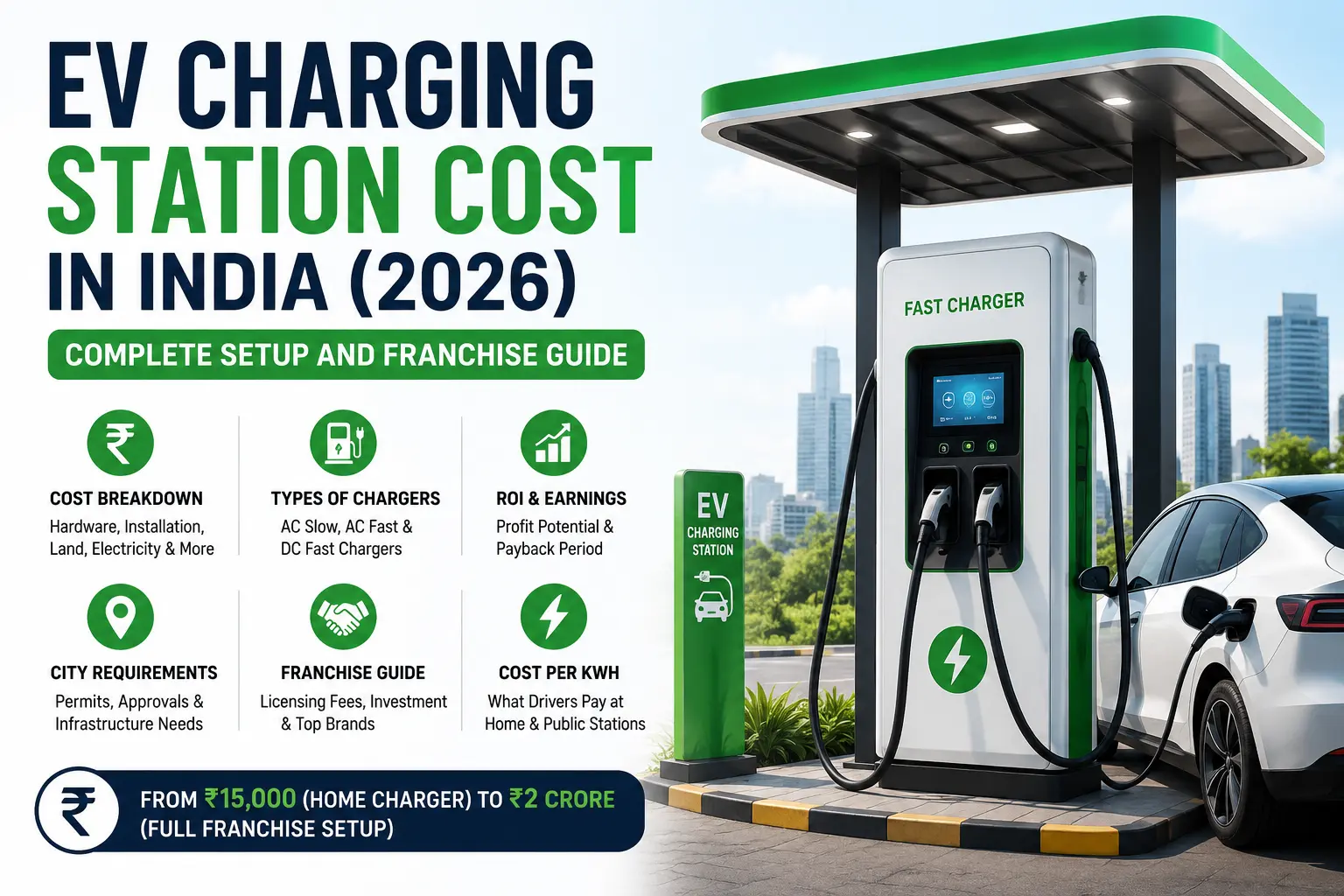
The range is wide because “cost” means different things depending on what you’re building. A basic home AC charger costs ₹15,000–₹30,000 just for hardware and installation. A full commercial 30kW DC fast-charging station, including civil work, electricity connection, land, and software, typically runs ₹10.9–14.65 lakh.
If you are going the franchise route, licensing fees alone are usually ₹1–2.5 lakh, while a complete turnkey multi-charger franchise setup with a major brand can cost ₹1–2 crore. Charging an EV itself typically costs ₹5–9 per kWh at home and ₹11–24 per kWh at public stations.
This blog breaks down every layer of the charging station cost in India: hardware vs. total setup, recurring expenses, city-specific requirements, franchise comparisons, and real ROI numbers.
How Much Does an EV Charging Station Cost in India?
The cost of EV charging stations in India ranges from ₹15,000 for a basic home charger to ₹1–2 crore for a full franchise-backed commercial station, depending on charger power and what’s included in the setup.
| Setup Type | Cost | What’s Included |
|---|---|---|
| Home AC charger | ₹15,000 – ₹30,000 | Hardware + basic install |
| Commercial AC (7.4–22kW) | ₹50,000 – ₹2L | Hardware only, offices/apartments |
| 30kW DC charger — hardware only | ₹7L – ₹8.5L | Charger unit alone |
| 30kW DC — full station setup | ₹10.9L – ₹14.65L | Hardware + civil work + electricity + land + software |
| High-power DC (up to 400kW) | ₹15L – ₹30L+ hardware | Highway/premium sites, station total higher |
| Franchise licensing fee only | ₹1L – ₹2.5L | Fee alone, some brands waive it |
| Full turnkey franchise setup | ₹1Cr – ₹2Cr | Fee + multi-charger site + civil work + brand support |
Note: The charging station cost varies widely because the hardware price, total setup cost, and franchise investment are three different numbers.
Types of EV Chargers and Their Cost
The type of charger you choose is the single biggest factor in your electric vehicle charging station cost, power output and connector type. And vehicle compatibility, all of which scale the price up or down. Here’s how the three main categories break down.
AC Slow Chargers (Level 1)
Level 1 AC chargers deliver up to 3.5kW and are the entry point for EV charger installation at home or in small residential setups. [EV charger installation] Hardware costs range from ₹15,000 to ₹30,000, and they are compatible with two-wheelers and three-wheelers. And four-wheelers via Type 1 or Bharat AC-001 connectors.
Best for: Home charging, overnight residential use, low-traffic locations where a full charge over several hours is acceptable.
AC Fast Chargers (Level 2)
Level 2 AC chargers step up to 7.4–22kW and are the standard choice for commercial and semi-commercial sites. Hardware costs typically run ₹50,000 to ₹2 lakh before installation and civil work are added. These support Type 1, Type 2, GB/T, and Bharat AC-001 connectors, making them compatible with most EVs on Indian roads today.
Best for: Offices, apartment complexes, malls, and any site where vehicles are parked for 2+ hours.
DC Fast Chargers (Level 3)
DC fast chargers range from 30kW up to 400kW and are what most people mean when they picture a commercial EV charging station. Hardware alone costs ₹5 lakh to ₹15 lakh depending on power output — a 30kW unit sits at the lower end (₹7L–8.5L), while high-power 120kW+ chargers push past ₹15L for hardware.
Once civil work, electricity connection, land, and software are added, a full 30kW station typically totals ₹10.9L–14.65L, worth keeping in mind, since charger price alone understates the real setup cost.
Best for: Highway corridors, malls, retail hubs, and any location where fast turnaround (20–60 minutes) matters more than charging cost per unit.
EV Charging Cost Per kWh in India (What Drivers Pay)
EV charging station prices vary the most from state to state and by charger type.
Typical per-kWh rates in India:
| Charging Type | Rate (₹/kWh) |
|---|---|
| Home charging | ₹5 – ₹9 |
| Public AC charging | ₹11 – ₹16 |
| Public DC fast charging | ₹18 – ₹24 |
Home charging rates depend on your state’s domestic electricity tariff slab, so the actual number you pay can sit above or below this range depending on your monthly consumption and location.
What this looks like in practice:
- A Tata Tiago EV (roughly 13 kWh consumed per 100km) charged at home at ₹8/kWh costs about ₹104 per 100km.
- A Tata Nexon EV (roughly 15 kWh per 100km) charged at a public DC fast charger at ₹20/kWh costs about ₹300 per 100km.
- An MG Windsor EV (roughly 15 kWh per 100km in real-world city driving) charged at home at ₹8/kWh costs about ₹120 per 100km.
(Consumption figures above are approximate real-world averages and will vary by driving conditions, AC use, and traffic.)
For comparison, a petrol vehicle in the same segment typically costs ₹7–9 per km to run. It means even public DC fast charging usually works out cheaper per kilometre than fuel, and home charging is cheaper still.
EV Charging Station Setup Cost Breakdown
Most guides quote a single number for EV charging station setup cost and stop there. But, that number is really made up of several separate line items, plus a set of recurring monthly costs that continue long after installation. Understanding both is essential before you commit capital to an electric vehicle charging station setup.
One-Time Setup Costs
Using a 30kW DC fast-charging station as a reference point, here’s how the one-time investment typically breaks down:
| Component | Estimated Cost |
|---|---|
| Charger hardware | ₹7L – ₹8.5L |
| Installation & civil work | ₹1.5L – ₹2L |
| Electricity connection & wiring | ₹50,000 – ₹1L |
| Land (lease or purchase, annualised) | ₹1.2L – ₹2.4L |
| Signage & branding | ₹25,000 – ₹40,000 |
| CMS/software & payment integration | ₹20,000 – ₹35,000 |
| Permits, insurance & misc. | ₹25,000 – ₹50,000 |
| Total one-time setup cost | ₹10.9L – ₹14.65L |
Recurring Monthly Costs
The setup cost gets most of the attention, but recurring expenses are what determine whether a station stays profitable month over month:
| Recurring Item | Estimated Monthly Cost |
|---|---|
| DISCOM demand charges | Varies by sanctioned load and state tariff |
| Manpower (support/maintenance staff) | ₹10,000 – ₹20,000 |
| Routine maintenance | ₹5,000 – ₹15,000 |
| Insurance | ₹1,000 – ₹3,000 |
| CMS/software subscription | ₹2,000 – ₹10,000 |
| Franchise fee (if applicable) | Typically 2–5% of revenue |
At moderate utilisation, total monthly operating costs for a single 30kW station usually land between ₹25,000 and ₹60,000.
EV Charging Station Cost by City
The EV charging stations cost in India varies noticeably by city because each state’s electricity distribution company (DISCOM) sets its own EV tariff, subsidy structure, and connection process
Mumbai
Mumbai is served by either Adani Electricity or Tata Power Company Ltd. (TPCL), depending on the specific area. Both maintain a dedicated EV Charging Station tariff category (LT VI / HT VI) separate from standard commercial rates, with energy charges currently around ₹5/kWh plus applicable fixed and wheeling charges under MERC-approved tariffs. Adani Electricity also runs a Shared EV Charger program for housing societies, covering installation and 7 years of maintenance at no cost to the society, in exchange for a small property tax rebate arrangement.
Delhi
Delhi is served by BSES Yamuna, BSES Rajdhani, or Tata Power-DDL, depending on your zone. Delhi currently offers one of the lowest EV tariffs in India at ₹4.5 per kWh, plus a subsidy of up to ₹6,000 per charging point for the first 30,000 home/society/shop installations under the Delhi EV Policy.
Pune / Navi Mumbai
Both cities fall under MSEDCL (Maharashtra State Electricity Distribution Co. Ltd.), which follows Maharashtra’s state EV Policy 2025. The state offers a concessional EV tariff of roughly ₹5–5.5 per kWh (MERC-approved), with demand charges waived for commercial charging stations in the initial policy years, plus a Viability Gap Funding scheme covering a portion of charging infrastructure costs for charge point operators.
Bengaluru
Bengaluru falls under BESCOM, and Karnataka’s EV Policy (2023–2028) is one of the more commercially favourable in the country. A 25% capital subsidy on EV charging equipment, EV tariffs in the ₹5–6/kWh range, and a mandate for chargers every 3km within the city. Karnataka currently has the highest number of public charging stations of any state.
Note: Tariffs, subsidies, and connection charges change with policy updates. The figures above reflect current published rates as of 2026, but confirm the latest numbers with your DISCOM before finalising a budget.
How to Set Up an EV Charging Station in India: Step-by-Step
If you’re wondering how to set up electric vehicle charging station infrastructure from scratch, the process breaks down into seven manageable stages.
1. Score and shortlist your location
Before anything else, evaluate potential sites using EV density in the area, average dwell time (how long vehicles typically stay parked there), power/grid availability, and proximity to competing chargers.
2. Apply for a DISCOM connection
Submit your application to the relevant electricity distribution company for your area (see the city-specific utilities above). You’ll need KYC documents, proof of premises ownership or lease, and, for higher loads, a technical test report from a licensed electrical contractor.
3. Secure land and permits
If you don’t already own the site, finalise your lease agreement first, since utilities require proof of premises before processing a connection. EV charging station installation in India is de-licensed — you don’t need a special business license. But you will still need standard permits: Municipal NOC where applicable, fire safety clearance for higher-capacity DC installations. And compliance with Central Electricity Authority (CEA) technical and safety standards.
4. Procure your chargers
Decide between AC and DC based on your site type (see the “Types of EV Chargers” section above), then either purchase directly from a manufacturer (Okaya, Servotech, Exicom, Delta, ABB India) or go through a franchise/partner brand that supplies chargers as part of the package.
5. Complete civil work and installation
This covers transformer/electrical upgrades where needed, cabling, foundation work for the charger unit, and physical installation. All of which should be handled by licensed electrical contractors, both for safety compliance and to avoid invalidating equipment warranties.
6. Integrate CMS and payment software
Every public charging station needs a Charge Management System (CMS) for remote monitoring, billing, and app-based discovery. This is what lets EV drivers actually find and pay for your station. If you’re using a franchise/partner model, this is usually bundled in; if you’re operating independently, you will need to set this up (or list on) a separate platform.
7. Launch and market the station
List your station on discovery apps (Google Maps, PlugShare, and network-specific apps), install clear signage, and consider local marketing to nearby residential societies, offices, or fleet operators if that’s your target user base.
How to Choose the Right Location
Location decides utilisation more than any other factor. Score potential sites against these five criteria before committing.
1. EV density in the area
Check EV registration data for the PIN code or check nearby residential societies, offices, or fleet depots for existing EV ownership. Higher density = faster utilisation ramp-up.
2. Average dwell time of the site type
Match charger type to how long vehicles actually stay:
2–8 hours (offices, malls, hotels) → AC chargers
15–45 minutes (highways, quick-stop urban spots) → DC fast chargers
3. Power/grid availability
Confirm the sanctioned load capacity with the local DISCOM before finalising a site. A great location with no three-phase supply or an undersized transformer means costly grid upgrades before you can install anything.
4. Distance from competing chargers
Check discovery apps (PlugShare, Google Maps) for existing stations within a 3–5km radius. Too close to established competition splits utilisation; too far from any EV traffic corridor risks low footfall.
5. Footfall type
Match the model to the location:
Residential → subscription/membership revenue, predictable but capped
Highway/transit → pay-per-use, higher margin per session, less predictable volume
Retail/mall → mixed, benefits from ancillary revenue (advertising, co-located retail)
Is a License Required to Set Up an EV Charging Station?
No. EV charging station installation in India has been de-licensed by the Ministry of Power since 2018; no separate distribution license is needed to sell electricity for EV charging. You do, however, need to comply with technical and safety standards set by the Central Electricity Authority (CEA), register as a Charge Point Operator (CPO) with your local DISCOM, and use BIS-certified chargers meeting IS 17017 series standards.
Official reference: e-AMRIT – EV Charging Station Installation Guidelines (Government of India)
State-Wise Subsidy Snapshot
| State | Key Incentive | Notes |
|---|---|---|
| Maharashtra | 15% Viability Gap Funding (up to ₹10L per DC fast charger) via EV Policy 2025; demand charges waived for initial years | Concessional tariff ~₹5–5.5/kWh (MERC-approved) |
| Delhi | 100% subsidy up to ₹6,000/charging point (first 30,000 units) | EV tariff ~₹4.5/kWh, one of the lowest nationally |
| Gujarat | 25% capital subsidy on public charging installations; 100% electricity duty exemption | Duty exemption alone cuts effective energy cost by ~15% |
| Karnataka | 25% capital subsidy on charging equipment | EV tariff ~₹5–6/kWh; mandates chargers every 3km in Bengaluru |
| Tamil Nadu | Up to 50% land cost subsidy for EV projects in southern districts; 100% road tax waiver | Policy is weighted toward manufacturing, but charging infra benefits indirectly |
| Uttar Pradesh | 20% subsidy on fixed capital investment, up to ₹10L per station — including grid/transformer equipment | First state to subsidise upstream electrical infrastructure (June 2025) |
Central scheme: PM E-DRIVE (replaced FAME II, October 2024–March 2028) allocates ₹2,000 crore specifically for charging infrastructure, targeting ~72,000 new public chargers, with subsidy coverage of 70–100% of eligible costs depending on location type.
Official references: myscheme.gov.in – Gujarat State EV Policy | EV Gujarat Web Portal – Incentives
Common Mistakes to Avoid
Overpaying for franchise royalty. Franchise brands offer real value in software, branding, and support. Compare 2–3 options before committing, and run the math on what an independent setup (own equipment + third-party CMS/listing) would cost over 3–5 years. Sometimes the franchise premium is worth it; sometimes it isn’t.
Ignoring utilisation data before committing to a site. A location that appears visible and accessible can still underperform if EV density and dwell time don’t align with your charger type. Score the site against the framework above before signing a lease.
Wrong charger mix for the site type. Installing DC fast chargers at a location where vehicles park for hours (offices, residential societies) wastes capital. AC chargers would serve the same demand at a fraction of the cost. Conversely, AC-only chargers at a highway or quick-stop location will frustrate drivers who need a fast top-up and leave.
Skipping DISCOM load sanction before starting civil work. Some operators begin construction assuming their power requirement will be approved, only to find the sanctioned load is lower than needed or the connection process takes longer than planned.