Cheapest Electric Car in India 2026: Full Price List and Buying Guide

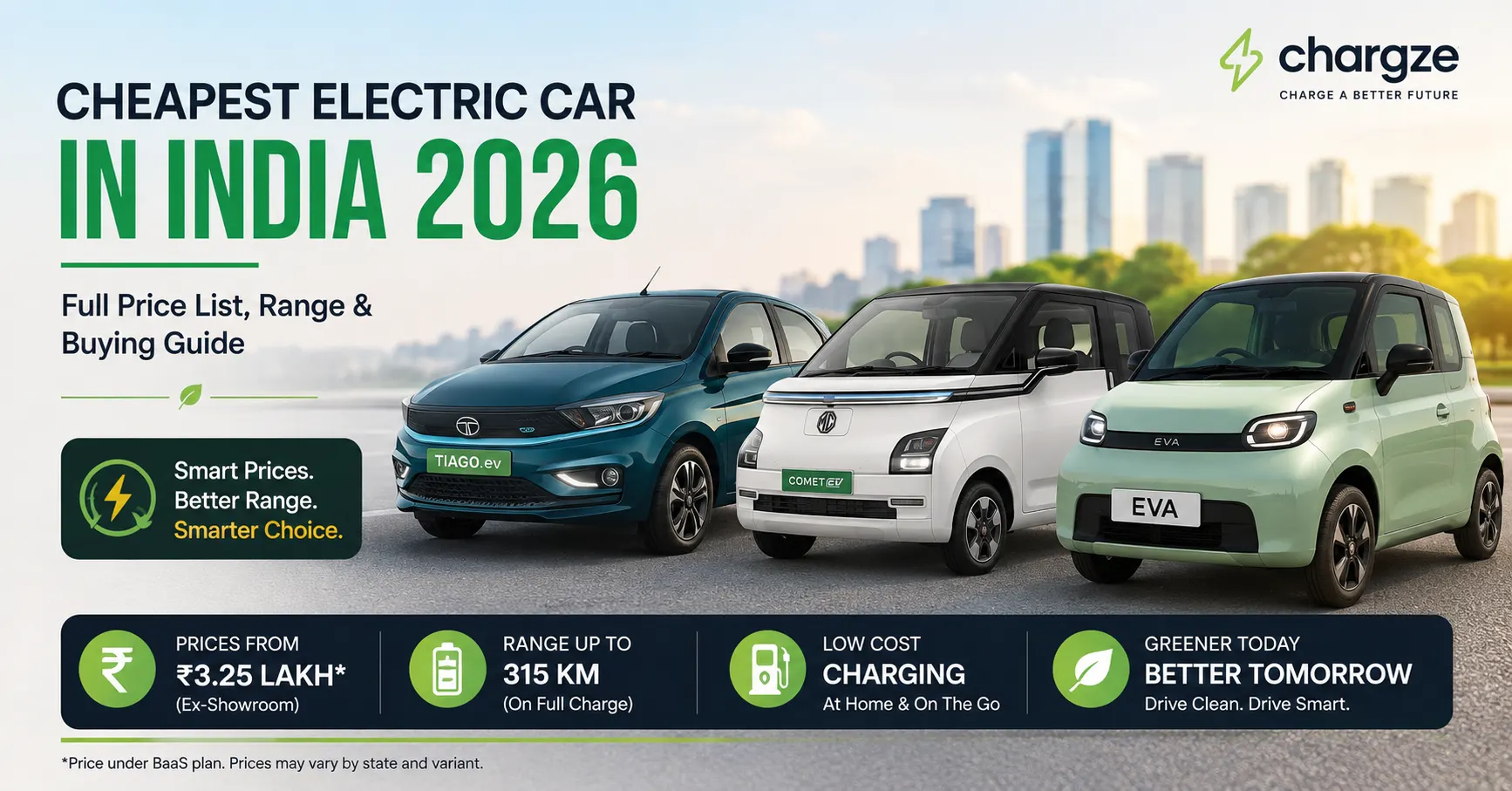
The cheapest electric car in India in 2026 is the Vayve Mobility Eva, starting at ₹3.25 lakh under its Battery as a Service plan, or ₹3.99 lakh with the battery included. Among traditional four-door hatchbacks from established brands, the Tata Tiago EV leads at ₹5.84 lakh to ₹6.99 lakh, followed by the MG Comet EV at ₹6.41 lakh.
This guide breaks down every budget EV on sale in India right now, its real-world range, and what it actually costs to charge and run each month.
Cheapest Electric Cars in India (Full Price Table)
Here is the complete, sorted list of budget EVs on sale in India right now, so you can scan prices and specs in seconds.
| Car | Ex-Showroom Price | Range | Body Style | Official Link |
|---|---|---|---|---|
| Vayve Mobility Eva | ₹3.25 lakh (BaaS) / ₹3.99 lakh | 125 to 250 km | 2-seater micro EV | vayvemobility.com |
| Tata Tiago EV | ₹5.84 lakh to ₹6.99 lakh | 250 to 315 km | 4-door hatchback | tiagoev.tatamotors.com |
| MG Comet EV | ₹6.41 lakh | 230 km | 2-door compact | mgmotor.co.in |
| Tata Punch EV | ₹8.09 lakh to ₹9.69 lakh | 315 to 421 km | Mini-SUV | punchev.tatamotors.com |
Each car name links straight to its official model page, so readers can check local pricing or book a test drive directly from this table.
Vayve Mobility Eva: India's Cheapest EV
The Vayve Mobility Eva tops this list because it uses a pricing model most other EVs in India don’t offer, Battery as a Service. This single feature drops its starting price below every other electric car on sale right now.
Battery as a Service, or BaaS, works differently from a normal car purchase. Instead of buying the battery outright, you buy the car itself at a lower price and then pay a separate monthly or per-kilometer fee to use the battery. This keeps the upfront cost down since the battery, usually the most expensive part of an EV, isn’t included in that ₹3.25 lakh price.
This model comes with a clear trade-off. You save significantly on the purchase price, but you take on a recurring subscription cost for the life of the car. Over several years, that subscription can add up close to what you would have paid for the battery upfront. Buyers should run the math on their expected usage before deciding if BaaS saves money or just spreads the cost out.
The Eva is built for short city commutes, with a compact two-seater design and a range between 125 and 250 km depending on the battery pack chosen. It suits someone who drives mostly within city limits and wants the lowest possible entry price into EV ownership.
Check current pricing and offers directly at vayvemobility.com.
Tata Tiago EV: Best Budget Hatchback
The Tata Tiago EV is the practical choice for families who want a proper four-door electric car without stretching their budget. It remains the best-selling EV in its segment for a reason.
The Tiago EV comes with two battery options. The 19.2 kWh pack delivers a claimed range of 226 to 250 km, with real-world driving usually landing around 160 to 170 km. The larger 24 kWh pack pushes the claimed range up to 285 to 315 km, with real-world figures closer to 205 to 215 km. Both packs support DC fast charging, adding close to 100 km of range in just 18 minutes.
This car outsells other budget EVs because it doesn’t ask buyers to compromise on space or practicality. It seats five, offers a proper boot, and drives like a familiar hatchback rather than a compact city runabout. That combination of everyday usability and a starting price under ₹7 lakh makes it the default recommendation for most first-time EV buyers in India.
Check current pricing and book a test drive at tiagoev.tatamotors.com, or read the full test drive report at autocarindia.com.
MG Comet EV: Best Compact City EV
The MG Comet EV suits buyers who live in dense cities and drive mostly short distances, think daily office commutes, errands, and school runs under 40 km a day. It’s built as a second car for households already owning a larger vehicle, or a first car for someone who never leaves city limits.
Its two-door, four-seater layout keeps the footprint tiny, just under 3 meters long, which makes parking and tight U-turns effortless in crowded city traffic. The compact size is the whole point of this car, not a compromise.
Charging happens through a standard 3.3 kW AC home charger, taking around 7 hours for a full charge from empty. Higher variants with a 7.4 kW fast charger cut that down to roughly 3.5 hours. There’s no DC fast charging option, so owners rely entirely on charging at home or at the office overnight.
The Comet EV fits best for young professionals, first-time car buyers, or urban households wanting a stress-free, low-maintenance second vehicle. It offers a claimed range of 230 km, which comfortably covers a week of typical city driving on one charge.
Check current pricing and variants at mgmotor.co.in.
Tata Punch EV: Best Budget Electric SUV
The Tata Punch EV is the step-up pick for buyers who want more space, more range, and SUV styling without leaving the budget segment. It suits families who need a bigger cabin and boot than a hatchback offers, plus the confidence of a taller ride height.
The Punch EV comes in five variants, Smart, Smart+, Adventure, Empowered, and Empowered+ S, across two battery packs. The 30 kWh pack delivers a real-world range of 260 to 275 km, while the 40 kWh pack extends that to 335 to 355 km real-world, with an ARAI-certified figure of 468 km. Fast charging on the 40 kWh pack takes the battery from 20 to 80 percent in just 26 minutes.
Pricing runs from ₹9.69 lakh to ₹12.79 lakh ex-showroom for full ownership. Tata also offers a battery rental plan that lowers the entry price to ₹6.49 lakh, similar to the BaaS model used by the Vayve Eva and MG Comet, for buyers who want a lower upfront cost.
This car fits buyers moving up from a hatchback who want extra boot space, six airbags as standard, and a 5-star BNCAP safety rating without stepping into a pricier SUV segment. Check current pricing and variants at punchev.tatamotors.com.
Ready for the “What It Actually Costs to Charge These EVs” section next, the one built to highlight Chargze’s own data and drive that internal link.
What It Actually Costs to Charge These EVs
The purchase price only tells half the story. What you pay to charge these cars every month determines whether an EV actually saves you money over time.
Charging at home costs the least. Most Indian households pay between ₹7 and ₹9 per unit (kWh) of electricity, depending on the state and usage slab. A full charge on the Vayve Eva (roughly 4 kWh usable) costs around ₹30 to ₹36. The Tata Tiago EV, with its 19.2 to 24 kWh battery, costs approximately ₹150 to ₹215 for a full home charge. The MG Comet EV, at 17.3 kWh, runs about ₹135 to ₹155. The Tata Punch EV, with its larger 30 to 40 kWh packs, costs roughly ₹235 to ₹360 for a full charge at home.
Public fast charging costs more, usually between ₹18 and ₹22 per unit on most networks in India, since you’re paying for speed and infrastructure. That same full charge on a Tata Punch EV’s 40 kWh battery jumps to around ₹720 to ₹880 at a public DC fast charger, compared to roughly ₹280 to ₹360 at home. This gap is exactly why most EV owners charge overnight at home and reserve public charging for road trips or top-ups.
[Note: swap these figures for Chargze’s actual published rate card once you confirm current per-unit pricing across the network, since public charging tariffs vary by state and operator.]
Even with public charging costs factored in, an EV still runs far cheaper per kilometer than a petrol car. Use Chargze’s charging cost calculator to work out your exact monthly cost based on your car, daily driving distance, and home electricity rate, or find your nearest charging station on chargze.com before you need it.
Cheapest Electric Car vs Petrol Car: Running Cost Comparison
This is the number that actually convinces buyers to switch. A price tag matters, but the cost per kilometer over years of ownership decides whether an EV genuinely saves money.
Petrol currently costs around ₹102 to ₹112 per litre across major Indian cities, with Delhi at ₹102.12 and Mumbai at ₹111.21 as of August 2026. A typical budget petrol hatchback returns about 18 to 20 km per litre in real-world city driving. Electricity at home costs roughly ₹7 to ₹9 per unit, and a budget EV covers close to 5 to 6 km per unit.
| Vehicle Type | Fuel Cost | Mileage/Efficiency | Cost per km |
|---|---|---|---|
| Petrol Hatchback | ₹102 to ₹112 per litre | 18 to 20 km per litre | ₹5.10 to ₹6.20 |
| Budget EV (home charging) | ₹7 to ₹9 per unit | 5 to 6 km per unit | ₹1.20 to ₹1.60 |
At these rates, a budget EV charged at home costs roughly one-fourth to one-fifth of what a petrol hatchback costs per kilometer. For a driver covering 1,000 km a month, that works out to a saving of ₹3,500 to ₹5,000 every month, money that stays in your pocket instead of going to the pump.
Frequently Asked Questions
Which is the cheapest electric car in India right now?
The Vayve Mobility Eva is the cheapest at ₹3.25 lakh under its Battery as a Service plan, or ₹3.99 lakh with the battery included. Among traditional hatchbacks, the Tata Tiago EV leads at ₹5.84 lakh to ₹6.99 lakh.
Is the MG Comet EV cheaper than the Tata Tiago EV?
No. The MG Comet EV starts at ₹6.41 lakh, while the Tata Tiago EV starts lower at ₹5.84 lakh. The Tiago EV also offers more space as a proper four-door hatchback.
What is Battery as a Service (BaaS) in electric cars?
BaaS lets you buy the car without the battery, lowering the upfront price, then pay a monthly or per-kilometer fee to use the battery. It reduces initial cost but adds a recurring subscription expense.
How much does it cost to fully charge a budget EV in India?
A full home charge costs between ₹30 for the Vayve Eva and ₹360 for the Tata Punch EV’s larger battery, depending on capacity. Home electricity typically runs ₹7 to ₹9 per unit.
Are budget EVs safe for highway driving?
Yes, models like the Tata Punch EV carry a 5-star BNCAP safety rating with six airbags standard. Range drops faster at highway speeds, so plan charging stops on longer trips.