Electric Cars Under ₹5 Lakh in India 2026: Full Price and Range Guide

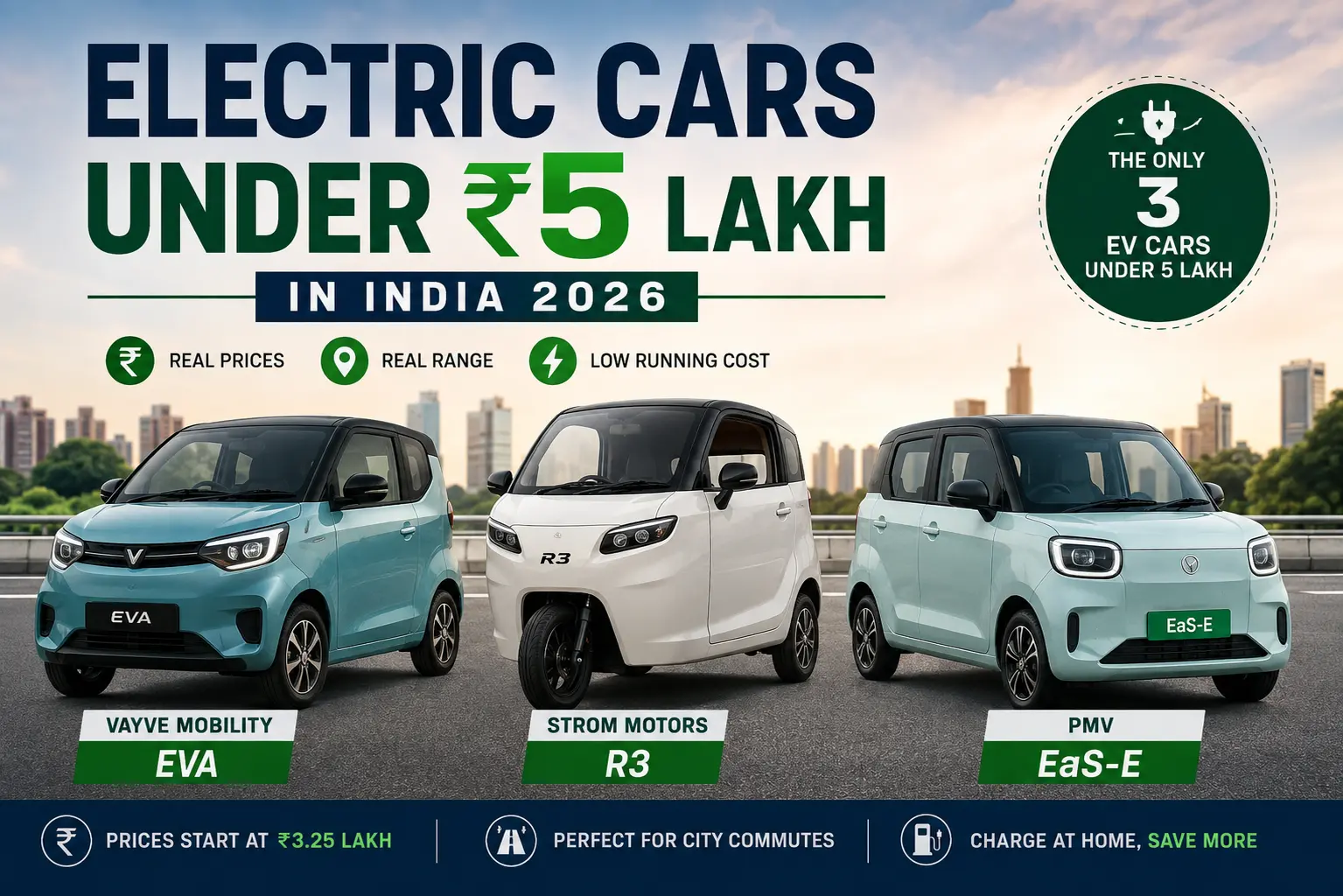
Vayve Eva, Strom Motors R3, and PMV EaS-E are the only three electric cars in India priced under 5 lakh right now. Yes, EVs under 5 lakh are real, but do not expect a full-size hatchback like the Tata Tiago EV or MG Comet.
These are compact two-seater city cars, built for short urban commutes, not long highway drives. They cost less than most petrol hatchbacks and run on just 50 paise to 1 rupee per kilometre.
This guide breaks down each car’s real price, range, and charging time, so you know exactly what fits your budget and daily commute. If you are searching for EV cars in India under 5 lakhs, you have three genuine options, and this post covers all of them honestly.
EV Cars Under 5 Lakhs in India: Quick Comparison
Here is a quick side-by-side look at the best EV under 5 lakh in India. Compare price, range, and charging time at a glance.
| Model | Price (Ex-showroom) | Range | Battery | Seats | Charging Time |
|---|---|---|---|---|---|
| Vayve Mobility Eva | ₹3.25L to ₹4.49L | 125 to 250 km | 9 / 12.6 / 18 kWh | 2 | 15 min DC (10 to 70%) |
| Strom Motors R3 | ₹4.50L | 200 km claimed | 48V system | 2 | 3 hrs |
| PMV EaS-E | ₹4.79L | 160 km | 10 kWh | 2 | Under 4 hrs |
Vayve Mobility Eva: Full Breakdown
The Vayve Mobility Eva is the cheapest EV in India right now. Prices start at ₹3.25 lakh for the base Nova variant and go up to ₹4.49 lakh for the top Vega trim. This Pune based startup built the Eva as India’s first solar assisted electric car, and it comes in three clear variants.
The Nova, the base model, runs on a 9 kWh battery and delivers 125 km of range. Step up to the Stella and you get a 12.6 kWh battery with 175 km of range. The top Vega variant carries an 18 kWh battery, pushing range up to 250 km on a full charge, the best figure in this entire price bracket.
All three variants offer an optional solar roof panel. Vayve claims the panel adds up to 10 km of free range each day, just from sunlight. It costs ₹20,000 on the Nova and Stella, and ₹25,000 on the Vega. Over a year of daily city driving, this can meaningfully cut your charging bill.
Charging is fast too. The Vega’s 18 kWh pack takes just 15 minutes to go from 10 to 70 percent on a DC charger. Using a regular 15A home socket, a full charge takes about 5 hours.
The Eva suits solo commuters and small families who mostly drive within city limits and want the lowest possible entry price into EV ownership. If you want proof this is genuinely the cheapest EV in India, book directly on Vayve’s official site, and check the full spec sheet on Zigwheels before you commit.
Strom Motors R3: Full Breakdown
The Strom Motors R3 is priced at ₹4.50 lakh ex-showroom. It claims a range of 200 km on a single charge, running on a 48 volt battery system.
Here is the detail that trips up most buyers. The R3 is not a four-wheel hatchback. It is a reverse trike, built with two wheels in front and one wheel at the back. Strom Motors designed it this way on purpose, since the layout cuts weight by nearly 40 percent compared to a standard hatchback, which helps the R3 stretch its small battery further.
Despite the three wheel layout, the cabin feels like a small car. You get two doors, two seats, a 300 litre boot, climate control, and a 7 inch touchscreen. Strom claims a running cost of just 40 paise per kilometre, and the battery takes about 3 hours to fully charge.
One thing worth knowing before you book. Strom Motors was acquired by Gensol Engineering, and Gensol has faced public financial and regulatory scrutiny recently. This does not mean the R3 is unavailable, but it is worth confirming current booking and delivery status directly with the brand before you pay any deposit.
The R3 suits solo commuters who travel short distances daily and do not mind the unconventional three wheel design in exchange for a lower running cost. Check current pricing and book on Strom Motors’ official site, and compare full specs on CarDekho.
PMV EaS-E: Full Breakdown
The PMV EaS-E is priced at ₹4.79 lakh ex-showroom. If you searched “which electric car is 4.79 lakh,” this is the answer. It is India’s most affordable electric quadricycle, built by the Mumbai based startup PMV Electric.
The EaS-E runs on a 10 kWh battery and delivers 160 km of range on a full charge. A regular 15A household socket charges it in under 4 hours, so you do not need a dedicated home charger to use it daily.
Two things to know before you shortlist this car. First, boot space is just 30 litres, noticeably smaller than most hatchbacks and even smaller than the Vayve Eva. It suits daily essentials, not grocery runs for a full week. Second, the EaS-E comes with only a single airbag. If safety features are a priority, weigh this honestly against the other two cars in this list before deciding.
On the upside, it includes useful tech for a car this size, cruise control, remote parking assist, and a top speed of 70 kmph, enough for city traffic.
The EaS-E suits buyers who want the lowest charging hassle and do not need much cargo space. Check availability and book on PMV Electric’s official site, and compare full specs on CarDekho.
Which One Should You Buy
All three cars work well for city use, but each one fits a different priority. Here is the fastest way to decide.
Tightest budget: Choose the Vayve Eva Nova. At ₹3.25 lakh, it is the cheapest EV in India, and still gives you 125 km of range for daily errands and short commutes.
Best range: Choose the Vayve Eva Vega. Its 18 kWh battery delivers 250 km, well ahead of the Strom R3 and PMV EaS-E, so you will charge less often even with regular use.
Shortest commute, low running cost: Choose the Strom Motors R3. Its 40 paise per km running cost is hard to beat, and 200 km of range comfortably covers most intra city trips, as long as you are fine with the three wheel layout.
If boot space and cargo room matter more than price, lean toward the Vayve Eva over the PMV EaS-E, since the EaS-E’s 30 litre boot is the smallest of the three.
Running Cost and Charging at Home
These EVs cost roughly ₹0.40 to ₹1 per kilometre to run. A comparable petrol hatchback costs ₹6 to ₹8 per kilometre at current fuel prices. Drive 1,000 km a month and you save close to ₹6,000, even before counting lower maintenance costs since EVs have far fewer moving parts.
None of these three cars need a dedicated fast charger at home. A standard 15A household socket handles a full charge overnight for all of them. If you want faster top ups, a basic 3.3 kW AC wall charger costs somewhere between ₹15,000 and ₹45,000 installed, depending on your home’s wiring and the charger brand you pick.
Before you install anything, get your electrical setup checked. Most housing societies in India need approval for a dedicated EV charging point, and your existing meter may need a load upgrade if you already run heavy appliances.
If home charging is not possible, or you need a top up while out, check Chargze to find public charging stations near you and compare real world charging costs before you plan a longer trip.
Government Subsidies on These EVs
Here is something most articles get wrong. The central PM E-DRIVE scheme does not cover electric cars. It applies only to two wheelers, three wheelers, e-buses, and e-trucks. FAME II, the older scheme that once supported four wheelers, closed in March 2024 and has not been replaced for cars.
The Strom Motors R3 is a notable exception worth checking. Since it is classified as a three wheeler, not a car, it may qualify for the e-3W subsidy under PM E-DRIVE. Confirm this directly with a dealer before you book, since eligibility depends on exact vehicle classification.
State level incentives still apply to all three cars in most states, including road tax waivers and registration fee exemptions, and these vary by state, so check your local RTO for current rates.
One benefit every buyer can use regardless of vehicle type is the Section 80EEB income tax deduction, worth up to ₹1.5 lakh on interest paid for an EV loan, provided you take the loan from a bank or notified financial institution.
Find a Charging Station Near You
Once you pick your EV, charging access matters more than the car itself. Whether you are running the Vayve Eva, the Strom R3, or the PMV EaS-E, you will still need a reliable place to top up on longer trips outside your home.
Use Chargze’s EV charging stations near me finder to locate the nearest working charger before you head out, so range anxiety never becomes a real problem.
Frequently Asked Questions
Which car is 3.5 to 4 lakh?
The Vayve Eva Stella variant fits this range at ₹3.99 lakh. It runs on a 12.6 kWh battery and delivers 175 km of range, sitting between the base Nova and the top Vega variant in both price and performance.
Which electric car is 4.79 lakh?
The PMV EaS-E is priced at exactly ₹4.79 lakh ex-showroom. It is a two seater electric quadricycle with a 160 km range, built by the Mumbai based startup PMV Electric, and is currently India’s most affordable electric four wheeler in this price bracket.
Which is the cheapest EV car?
The Vayve Eva Nova is the cheapest EV in India, priced at ₹3.25 lakh. It runs on a 9 kWh battery and offers 125 km of range, making it the lowest cost entry point into EV ownership right now.
Which EV car gives 700 km range?
No EV under 5 lakh comes anywhere close to 700 km. The best in this bracket is the Vayve Eva Vega at 250 km. A 700 km range belongs to premium EVs priced well above 40 lakh, a different category entirely.