Portable EV Charger Guide: Types, Safety & Best Picks (India)

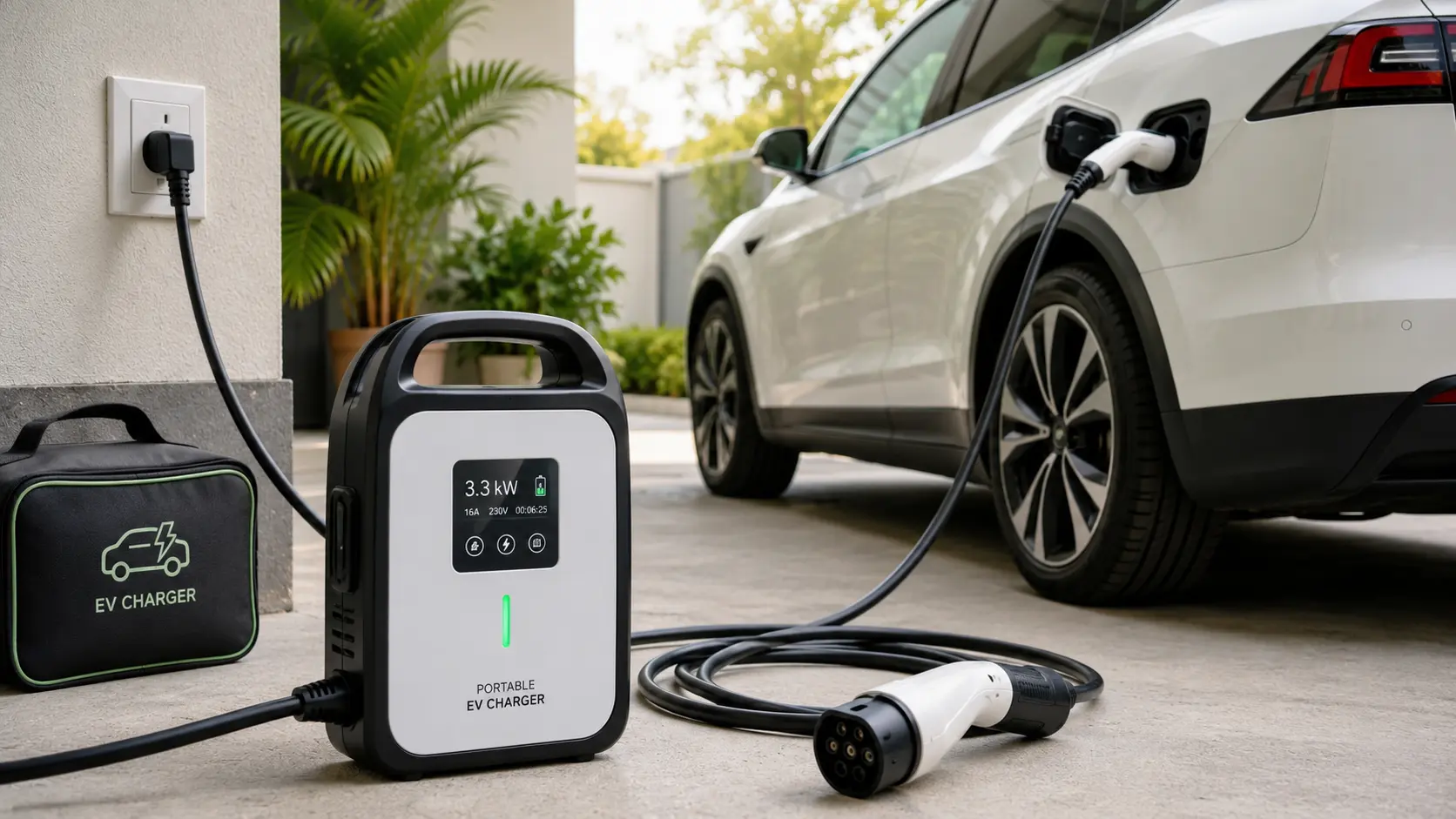
A portable EV charger lets you charge your electric vehicle from any compatible socket, without relying on a fixed home charging point. It gives you a backup option when public charging stations are unavailable or far away. You simply plug it in, connect it to your car, and charge wherever you are.
This guide is for new EV owners setting up their first charging routine. It’s also for road trippers who want a safety net on longer drives. Apartment dwellers without dedicated parking or a home wallbox will find it useful too.
Whether you’re comparing your first portable charger or upgrading an old one, this guide covers the models, safety practices, and costs you need to make the right choice.
What Is a Portable EV Charger? Level 1 vs Level 2
A portable EV charger is a compact, plug-in device that charges your electric vehicle from a standard or high-power socket, without needing a fixed wall-mounted charging station. Portable chargers generally come in two types, and knowing the difference helps you pick the right one.
Level 1 chargers plug into a standard household socket, the same one you’d use for a fan or a kettle. They’re slow, typically adding just a few kilometres of range per hour. They work well as an occasional backup, not a daily charging method.
Level 2 chargers need a 240V outlet, similar to what a washing machine or geyser uses. They charge significantly faster, making them a better fit if you plan to rely on your portable charger regularly.
| Feature | Level 1 | Level 2 |
|---|---|---|
| Speed | Slow (a few km of range per hour) | Faster (meaningfully more range per hour) |
| Outlet needed | Standard household socket | 240V outlet |
| Best for | Occasional backup charging | Regular or daily portable charging |
If you’re mostly topping up occasionally, a Level 1 charger may be enough. If you plan to depend on portable charging more often, a Level 2 charger is worth the higher cost and outlet requirement.
Do You Actually Need a Portable EV Charger?
Not every EV owner needs a portable charger. It depends on your access to home charging and how often you travel to areas without reliable charging infrastructure.
Here’s how to think about it based on your situation:
- Apartment dwellers without dedicated parking often can’t install a fixed home wallbox. A portable charger gives you a way to charge from a shared or nearby socket when needed, even without permanent infrastructure.
- Frequent long-distance travelers benefit from carrying a portable charger as a safety net. On routes with gaps in charging infrastructure, it means you’re never fully stranded, even if it only offers a slow top-up.
- Owners with reliable home or nearby public charging may not need one at all. If you already charge consistently at home or have a trustworthy charging network nearby, a portable charger becomes a backup you rarely use rather than a necessity.
Public charging networks are a legitimate alternative for many EV owners, especially those who charge mostly on the go rather than at home. If fast, reliable stations are already part of your routine, that convenience alone may cover your needs without adding a portable charger to your kit.
Key Features to Look for When Buying
Choosing the right portable EV charger comes down to a handful of key features.
- Power output (kW): Higher kW means faster charging, but check your car’s onboard charger limit first, since a bigger charger won’t help if your vehicle can’t accept the extra power.
- Connector type: Confirm the charger uses Type 2 or CCS2, matching your EV’s charging port.
- Cable length: A longer cable gives you flexibility when the socket isn’t right next to your parking spot.
- IP weather rating: Look for IP65 or higher if you’ll use the charger outdoors or in India’s monsoon conditions.
- Certification: Choose chargers with BIS or ARAI certification, confirming they meet Indian safety standards.
- Portability: Check the weight and size, since you’ll likely store it in your car’s trunk or boot.
- Smart features: App control, adjustable current, and real-time charging data add convenience, though they’re not essential for basic use.
Prioritise power output, connector compatibility, and certification first. Smart features are worth paying extra for only if you’ll actually use them.
Best Portable EV Chargers in India
Here are some of the most reliable portable EV chargers available in India right now, compared side by side.
| Model | Power Output | Connector / Plug | Cable Length | Indicative Price | Best For |
|---|---|---|---|---|---|
| Statiq Portable EV Charger (IC-CPD) | 3.3 kW | Standard 3-pin, 16A domestic plug | Not specified by brand | ₹14,999 (introductory; MRP ₹28,999) | First-time buyers wanting an affordable, certified backup charger |
| Tata Nexon EV Portable Charger (Stanley) | 7.3 kW | Type 2, IEC 62196-2, 32A | Not specified by seller | ~₹20,930 | Tata EV owners who want faster portable charging |
| Synergy 3.3kW Portable Charger | 3.3 kW | Standard socket (Delta charger) | Not specified by seller | ~₹17,500 | Apartment or home use on a tighter budget |
| Servotech 3.3kW Portable Charger | 3.3 kW | Standard socket, indoor/outdoor rated | Not specified | ~₹25,600 (also sold in a wider ₹20,000–₹75,000 range depending on configuration) | Buyers who want a recognized Indian brand with wide service reach |
| Zevpoint Aveo 3.6 / Aveo Pro | 3.6 kW to 7.5 kW | CEE socket, adjustable current | 5–6 metre TPU cable | Check current listing | Buyers who want app control, IP66 weatherproofing, and a 5-year warranty |
Prices above are indicative, pulled from brand and marketplace listings at the time of writing, and will shift with offers, configuration, and retailer. Always confirm current pricing and specifications directly with the seller before purchasing.
- Statiq Portable EV Charger (IC-CPD) is one of the most accessible entry points into portable charging. At 3.3 kW with IP66 weatherproofing and RCD Type-B leakage protection, it’s built to double as a primary home charger or a travel companion, backed by a 2-year warranty.
- Tata Nexon EV Portable Charger steps up to 7.3 kW with a 32A Type 2 connector, making it a natural fit if you already drive a Tata EV and want noticeably faster charging than a standard 3.3 kW unit offers.
- Synergy 3.3kW Portable Charger is a straightforward, budget-friendly option built around Delta charging hardware, well suited to apartment or home use where you don’t need the fastest possible charge.
- Servotech 3.3kW Portable Charger comes from one of India’s larger EV charging manufacturers, with a broader service network behind it. Servotech’s own pricing guidance places AC chargers generally between ₹20,000 and ₹75,000 depending on power rating and features, so treat the exact model price as a starting point to verify.
- Zevpoint Aveo series targets buyers who want smart features alongside portability: adjustable current, a carry bag, wall bracket, and IP66 weatherproofing, with warranties extending up to 5 years on some models.
How to choose between them: if you’re a first-time buyer wanting an affordable, certified backup, Statiq’s entry-level pricing is hard to beat. If you drive a Tata EV and want faster charging on the go, the Tata Nexon portable charger’s higher power output is worth the extra cost. If smart app features and a longer warranty matter more to you than price, the Zevpoint range is worth a closer look.
Whatever you choose, confirm three things before buying: the connector matches your EV, the certification (BIS or ARAI) is genuine, and the seller offers real local warranty support, not just a listing on a marketplace.
Is It Safe to Charge from a Normal Socket?
Occasional charging from a properly wired socket is safe. Daily charging from an unrated socket or an extension board is a real fire risk.
A portable charger pulls high current for hours at a time. Most household sockets and extension boards aren’t built for that kind of continuous load. Here’s what to keep in mind:
- Never use extension boards or power strips. These are designed for short bursts of low current, not hours of steady, high-current draw. Using one to charge your EV can overheat the plastic and start a fire.
- Check that your socket is rated for continuous load. A standard 16A socket wired correctly can usually handle occasional slow charging. But an old, loose, or poorly wired socket can overheat even without an extension board involved.
- Consider a dedicated circuit if you charge portably at home often. If you’re relying on your portable charger daily rather than occasionally, it’s worth having an electrician install a dedicated circuit with proper earthing and a correctly rated breaker. This removes the risk that comes with sharing a socket with other appliances.
If your socket ever feels warm, smells odd, or trips repeatedly during charging, stop using it and have it inspected before you plug in again. A portable charger is convenient, but it’s still mains electrical equipment, and it deserves the same respect you’d give any other high-power appliance.
Portable EV Charger Cost in India
A portable EV charger in India typically costs between ₹15,000 and ₹30,000, depending on power output, brand, and features, with electricity running costs separate from that hardware price.
The hardware price depends mostly on power output and included features. Basic 3.3 kW units start around ₹15,000, while higher-output models with app control and extended warranties can run closer to ₹30,000 or more.
Running cost is a separate number, and it’s easy to overlook. Domestic electricity in India typically costs between ₹6 and ₹10 per unit (kWh), which works out to roughly ₹1 to ₹1.5 per kilometre for most EVs. This cost stays the same whether you charge through a portable charger or a fixed home wallbox, since it’s the electricity itself, not the charging hardware, that determines what you pay per kilometre.
So when budgeting, separate the two numbers clearly: a one-time hardware cost for the charger, and an ongoing running cost tied to your electricity rate and how much you drive. A cheaper charger won’t lower your electricity bill, and a pricier one won’t raise it. The hardware only affects charging speed and convenience, not what you pay per kilometre driven.
How to Use a Portable EV Charger Safely
Follow these steps each time you use a portable EV charger to keep charging safe and reliable.
- Check that your socket is rated for continuous, high-current load.
- Inspect the cable and plug for cracks, fraying, or damage before each use.
- Plug the charger directly into the socket, never through an extension board.
- Connect the charger to your EV, then start the charging session.
- Monitor the charger during the first few minutes for unusual heat or sound.
- Avoid touching the connector or cable with wet hands.
- Let the charger complete the cycle without interrupting it unnecessarily.
- Disconnect the vehicle first, then unplug the charger from the breaker.
- Store the charger in a dry, protected space when not in use.
Portable Charger vs Public Charging Network
A portable charger and a public charging network solve different problems, and most EV owners end up using both rather than choosing one over the other.
A portable charger gives you independence. It works anywhere you find a compatible socket, which makes it valuable for travel, emergencies, or homes without a fixed charging point. The tradeoff is speed. Even a good portable unit charges slower than a dedicated public charger.
A public charging network, like Chargze, offers faster charging without any hardware to buy, maintain, or carry around. You simply pull up, plug in, and get back on the road in a fraction of the time. The tradeoff here is that you depend on station availability and location.
In practice, many EV owners carry a portable charger as a backup for the unexpected, while relying on a network for regular, fast top-ups during everyday driving. If you want to check charging options near you, you can find your nearest Chargze station through the app.
Conclusion
A portable EV charger is a smart backup, not necessarily a replacement for reliable, everyday charging access.
If you travel often, live in an apartment without dedicated parking, or simply want peace of mind, a portable charger is worth adding to your kit. Just remember to prioritise certification, connector compatibility, and safe socket practices over price alone.
If you’d rather rely on fast, dependable charging for your daily driving, a public network can cover most of what you need without any hardware to buy or maintain. You can find your nearest Chargze station and check real-time availability through the app.
Whichever route you choose, the goal is the same: charging that fits how you actually drive, without adding unnecessary risk or hassle to your routine.
Frequently Asked Questions
What is the difference between a portable EV charger and a home wallbox?
A portable charger is a compact unit you can move between sockets, while a home wallbox is fixed permanently and wired into a dedicated circuit. Wallboxes typically charge faster and offer a safer daily setup, while portable chargers offer flexibility for travel or backup use.
Can I carry a portable EV charger on a flight or train?
Airlines generally restrict lithium-ion batteries but treat portable EV chargers as electrical equipment rather than batteries, so rules vary by carrier and charger type. Check with your specific airline before flying, and for trains, most portable chargers are allowed as regular checked or carried equipment.
How much does a portable EV charger cost in India?
Portable EV chargers in India typically cost between ₹15,000 and ₹30,000, depending on power output, brand, and features. Basic 3.3 kW units sit at the lower end, while higher-output models with smart features and longer warranties cost more.
Is it safe to charge an EV from a regular wall socket?
Occasional charging from a properly wired socket is safe. Daily charging from an unrated socket or an extension board is not, since it can overheat and become a fire risk. For regular use, have an electrician install a dedicated circuit instead.
Do all portable EV chargers fit all EV models?
No. Portable chargers use specific connector types, most commonly Type 2 or CCS2 in India, so you need to match the charger to your EV’s charging port. Power output also matters, since your car’s onboard charger sets a limit on how fast it can actually charge.